

Store Management System
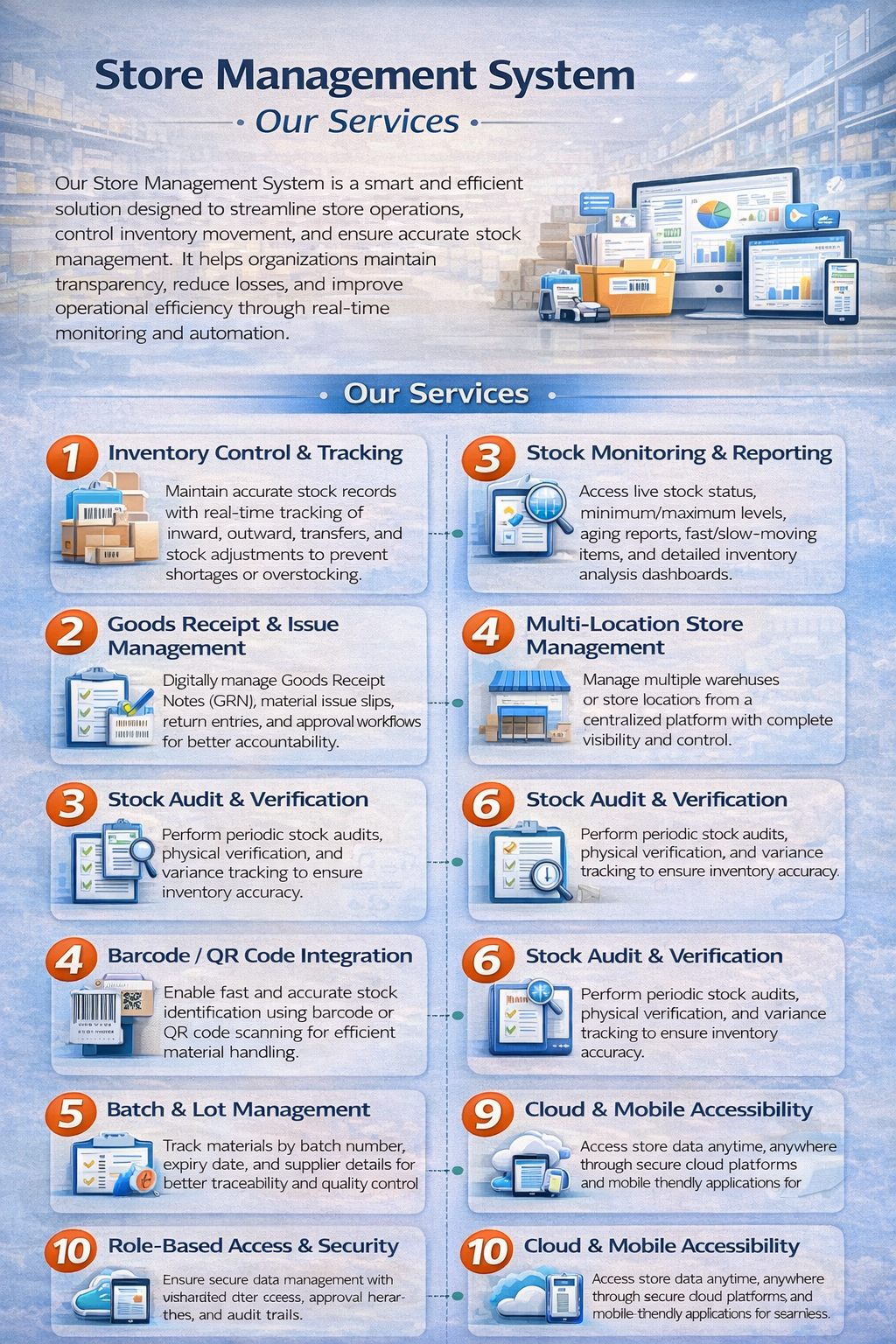
Our Store Management System is a smart solution designed to streamline store operations, control inventory movement, and ensure accurate stock management. It helps organizations maintain transparency, reduce losses, and improve operational efficiency through real-time monitoring and automation. The system tracks inward and outward materials, stock transfers, and adjustments to prevent shortages or overstocking.
The platform digitally manages Goods Receipt Notes (GRN), material issue slips, return entries, and approval workflows to improve accountability. With live stock monitoring and detailed dashboards, businesses can view real-time stock status, minimum and maximum levels, and fast or slow-moving item reports. It also supports multi-location store management for centralized control across warehouses or branches.
Barcode and QR code integration enable quick and error-free stock identification, improving material handling efficiency. In addition, stock audits, physical verification, and variance tracking maintain inventory accuracy. Batch and lot management features track materials by batch number, expiry date, and supplier details for better traceability.
Automated alerts notify users about low stock, expiring items, pending approvals, or unusual stock movement. Role-based access control, secure data handling, and audit trails ensure accountability and data security. Moreover, cloud and mobile access allow users to manage store operations anytime and anywhere.
Store Management System — Part of the LeMeniz Digital Factory
Store Management System to control inventory, track stock movement, manage GRN, barcode integration, and optimize warehouse operations. This module is part of LeMeniz’s Digital Factory suite of industrial automation software, giving manufacturing teams real-time dashboards, mobile access, and 500+ integration APIs to run store management system alongside the rest of their factory operations.
How LeMeniz Implements Store Management System
When manufacturers adopt Store Management System through LeMeniz’s Digital Factory platform, implementation typically starts with a short discovery call to map existing workflows, followed by configuration of the relevant dashboards and mobile views. Our team in Pondicherry handles setup, data migration, and staff onboarding directly, so plant teams are working inside the system within days rather than months.
Because Store Management System is built on the same Digital Factory core as our other modules, data flows between systems automatically. Every module ships with the same 500+ API library, real-time dashboards, and mobile access, so teams already using one Digital Factory product can adopt Store Management System without learning a new interface. Support is handled by the same LeMeniz Technologies team behind our broader software development services, not a separate vendor.
Frequently Asked Questions About Store Management System
How long does Store Management System take to set up? Most LeMeniz Digital Factory modules, including Store Management System, can be configured and handed over within a few weeks, depending on how much historical data needs to be migrated.
Does Store Management System work on mobile? Yes. Like every module in the Digital Factory suite, Store Management System includes mobile access so supervisors and operators can check status and receive alerts away from a desktop.
About LeMeniz Technologies
LeMeniz Technologies Private Limited is a software company based in Pondicherry, India, founded in 2016. Beyond client projects, the same engineering team designs, builds, and maintains the Digital Factory platform end to end, so every module reflects real operational feedback rather than assumptions about how a factory floor actually works. The company also provides mobile application development, website design, ecommerce solutions, and digital marketing alongside its industrial automation work, giving clients a single team to work with across very different kinds of projects.
Support requests are handled directly by the engineers who built the platform rather than passed through account managers or a separate support desk. That structure keeps response times short and avoids the kind of miscommunication that happens when a vendor’s development and support functions sit in different teams. Clients who start with one Digital Factory module often expand to others once they see how the underlying system fits together.